
Discover How to Build a Career in Architecture and the Built Environment
Are you passionate about buildings, design, technology and creating spaces that shape the world around us?
A career in the architectural and built environment sector offers opportunities to combine creativity, technical knowledge and digital design skills.
For prospective students in Cape Town and across South Africa, understanding the different architectural qualifications and career pathways is an important first step.
At CAD4ALL Institute of Applied Architecture & Digital Arts, students can explore specialised educational opportunities in architectural draughting, architectural technology and computer-aided design.
Whether you are completing matric, considering a career change or looking to strengthen your existing technical skills, choosing the correct qualification is essential.
What Is the Difference Between Architecture, Architectural Technology and Draughting?
Although these fields are closely related, they involve different areas of responsibility, academic preparation and professional development.
Architectural Draughting
Architectural draughting focuses on producing technical drawings, plans, elevations, sections and construction documentation and works in a registered architectural practice .
Architectural draughting students develop skills in interpreting design information, preparing drawings and using digital drafting technologies.
These skills can support work in architectural practices, construction-related businesses and technical design environments.
Architectural Technology
Architectural technology connects building design with the technical processes required to develop and document construction projects.
Students explore architectural drawing, building technology, construction methods, design communication and digital design applications.
Architectural technology qualifications can provide an academic foundation for further professional development, subject to the requirements of the relevant professional bodies.
Understanding Architectural Qualifications at CAD4ALL
CAD4ALL’s educational approach is designed around specialised technical competencies and recognised qualification pathways.
Architectural Draughtsperson — NQF Level 5
The Higher Occupational Certificate: Architectural Draughtsperson is positioned at NQF Level 5 and comprises 120 credits.
The qualification focuses on developing foundational technical draughting competencies relevant to architectural documentation and design support.
Students interested in architectural draughting should confirm the qualification’s accreditation, admission requirements and current professional recognition status before enrolling.
Importantly, this qualification must not be confused with a SACAP-recognised architectural professional qualification.
Diploma in Integrated Architectural Technology — NQF Level 6
CAD4ALL offers a Diploma in Integrated Architectural Technology at NQF Level 6, comprising 360 credits over three years.
Accredited by the Council on Higher Education, the diploma represents an important academic pathway for students seeking specialised higher education in architectural technology.
The programme supports the development of knowledge and competencies associated with architectural design, building technology, technical documentation and digital design.
Students should seek academic guidance regarding the diploma’s current SACAP validation or endorsement status and any additional requirements for professional registration.
Why Digital Design Skills Matter
Architecture and construction industries increasingly use digital systems to design, document and coordinate projects.
Students who understand these technologies can develop valuable technical capabilities relevant to modern workplaces.
Important software and technology areas include:
- AutoCAD: Widely used for computer-aided drafting and technical documentation.
- Autodesk Revit: A BIM application supporting intelligent building models, architectural documentation and interdisciplinary coordination.
- 3D Modelling: Used to visualise design ideas, communicate proposals and understand complex spatial relationships.
- Building Information Modelling: A collaborative process that connects building information with digital models throughout different stages of a project.
CAD4ALL’s approach recognises the value of combining academic study with relevant software training and opportunities for international certification.
Can You Study Architecture with Mathematical Literacy?
One of the most common questions prospective students ask is whether Mathematical Literacy can provide access to architecture-related studies.
The answer depends on the specific qualification and its approved admission requirements.
Different architectural and built environment programmes may have different subject requirements.
Students who completed Mathematical Literacy should not automatically assume that every architectural qualification is unavailable to them.
CAD4ALL encourages prospective applicants to request an individual academic consultation to establish which programmes they may qualify for.
Where applicable, alternative access arrangements or Recognition of Prior Learning may also be considered in accordance with the relevant admission policies.
Can You Progress from NQF Level 5 to NQF Level 6?
The National Qualifications Framework provides a structure for understanding different levels of learning and possible academic progression.
However, progression from one qualification to another is not automatic.
Students who complete an NQF Level 5 qualification and wish to pursue an NQF Level 6 diploma must satisfy the receiving programme’s admission requirements.
Any recognition of prior learning, credit transfer or advanced standing is subject to institutional academic policies and applicable regulations.
An academic consultation can help students understand their available options.
Career Opportunities in Architectural Technology
Depending on their qualification, practical experience and employer requirements, graduates may pursue opportunities in areas such as:
- Architectural draughting and documentation
- Architectural design support
- BIM modelling and documentation
- Technical design coordination
- Building technology support
- Construction documentation
- CAD and digital design services
Certain professional titles and categories of work are regulated and may require registration with SACAP or another relevant authority.
Why Choose a Specialist Architectural Education Institution?
A specialist institution provides an educational environment with a concentrated academic focus.
At CAD4ALL, architecture, architectural technology and digital design form an important part of the institution’s identity.
Students can benefit from an educational approach that values technical competence, practical projects, academic development and industry-relevant technologies.
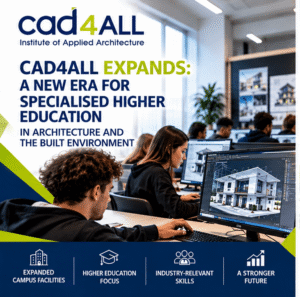
With its growing higher education provision and expanded campus facilities in Tygervalley, CAD4ALL continues to invest in specialised built environment education.
Start Your Architectural Education Journey
Choosing an architectural qualification is an investment in your future.
The right starting point depends on your school subjects, existing qualifications, career ambitions and the professional pathway you wish to pursue.
CAD4ALL encourages prospective students and parents to obtain clear academic guidance before making an enrolment decision.
Interested in studying architectural draughting or architectural technology?
Visit CAD4ALL Institute of Applied Architecture & Digital Arts at 281 Durban Road, Golden Isle Building, Tygervalley, Cape Town.
Book an academic consultation to discuss admission requirements, available qualifications, tuition arrangements and your future in the built environment.